


Danse macabre in G Minor, S. 555 – after Saint-Saëns, Op. 40 (Small-Hand Edition)-Camille Saint-Saëns / Franz Liszt
Piano Très diff.
$5.99
- Vidéo perf.
- Difficulté: Très diff.
- 20 Pages
Infos essentielles
- Instrument 1
- Piano
- Pages
- 20
- Difficulté
- Très diff.
- Type
- 2 port.
- Instrumentation
- Solo
- Paroles
- Non inclus
- Accord
- Non inclus
- Tonalité
- 2 bémols (3 changements de tonalité)
- Mesure
- 2/4 (1 changements de mesure)
- Mesures
- 670 mesures
- Étendue
- A♯0 – A7
- Voix max.
- 3 voix
- Doigtés
- Indiqués sur certains passages
- Sections
- 1
Description
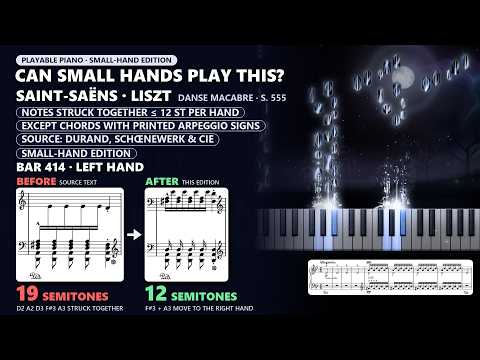
A PLAYABLE PIANO Small-Hand Edition of Franz Liszt's piano transcription of Camille Saint-Saëns's symphonic poem "Danse macabre", Op. 40, S. 555.
This is not a simplified or beginner arrangement. The goal is to preserve the original musical character, texture, and difficulty while redesigning selected physical hand-size barriers.
Repeated single D's open the piece; the waltz (Mouvement modéré de Valse, 3/4) begins in bar 31 with A and E-flat struck together, and the piece reaches fff in bar 522. In 23 of the 26 edited bars, selected notes are struck by the other hand (for example, in bar 414 the left hand's F-sharp 3 and A 3 move to the right hand; in bars 180 and 188 the moved D3 is written as a quarter note instead of an eighth); in bars 431, 488 and 490 the lowest left-hand note is printed as a small note before the beat; in bar 90 the B-flat 3 printed in both hands is struck by the right hand only, and the left-hand note becomes a rest. No roll signs are added.
• 670 measures; 19 pages of score and one page of editorial notes
• Apart from seven chords that carry a roll sign printed in the source (bars 389, 628 and 651–655; widest 17 semitones; left as printed), notes struck together in each hand span at most 12 semitones (one octave; grace notes not counted; a long note still sounding when later notes are struck is not counted with them) across the 670 measures of the MusicXML
• Edited bars (26): 26, 72, 74, 79, 88–94, 166, 180, 182, 188, 190, 247, 414, 416, 418, 420, 431, 456, 468, 488 and 490
• All changes are listed in the editorial notes in the score
• Files: PDF + MusicXML
Designed for pianists who can handle the musical and technical demands of the original work, but are limited by selected stretches beyond a comfortable octave.
Source: Durand, Schœnewerk & Cie, Paris.
PLAYABLE PIANO
We don't make hard music easy.
We make it more playable for smaller hands.
$5.99
