

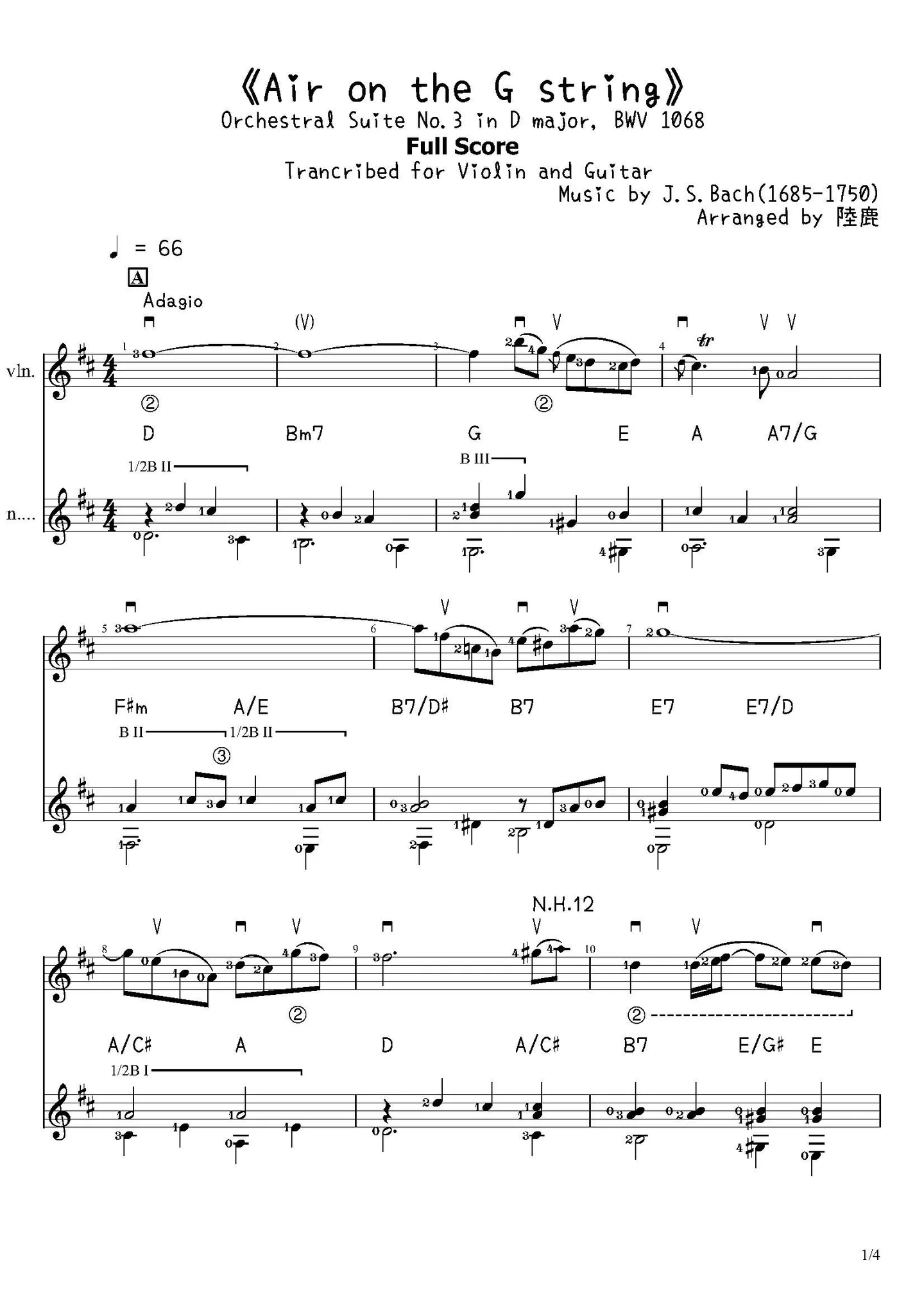


《Air on the G string》Trancribed for Violin and Guitar (Trancribed for Violin and Guitar)-J.S.Bach(1685-1750)
Violon Difficile
$7.00
- Vidéo perf.
- Difficulté: Difficile
- 8 Pages
Infos essentielles
- Instrument 1
- Violon
- Pages
- 8
- Difficulté
- Difficile
- Type
- 2 port.
- Instrumentation
- Vide
- Paroles
- Non inclus
- Accord
- Inclus
- Tonalité
- D majeur
- Mesure
- 4/4
- Tempo
- 66bpm
- Mesures
- 38 mesures
- Étendue
- E2 – C6
- Voix max.
- 4 voix
- Doigtés
- Indiqués tout du long
- Sections
- A
Description
一、作品背景
《Air on the G String》(G弦上的咏嘆調)出自 J.S. Bach(1685–1750)《第三號管弦組曲》(Orchestral Suite No.3 in D Major, BWV 1068)。
此曲原為巴洛克時期的舞曲組曲之一,約作於1720年代。全套作品共有五個樂章:
●Ouverture(序曲)
●Air(咏嘆調)
●Gavotte I & II(加沃特舞曲)
●Bourrée(布列舞曲)
●Gigue(吉格舞曲)
其中第二樂章〈Air〉最為人熟知,以其流暢優雅的旋律與平和氣息聞名。
「G弦上的咏嘆調」這一名稱來自19世紀德國小提琴家 August Wilhelmj(1845–1908) 的改編版本。他將原曲的旋律移至C大調,使得整段旋律可完全在小提琴的G弦上演奏,因此得名。
二、曲式與音樂特徵
🎵Tempo(速度):Adagio
🎵Key(調性):D Major
🎵Time Signature(拍號):4/4
🎵Form(曲式):二部曲式(Binary Form, A–A / B–B)
全曲以均衡的長句和持續的低音進行構成。旋律柔和而歌唱性強,低音部以穩定的四分音符脈動形成「行進式」伴奏,增添安定感與莊嚴氣氛。
三、小提琴與吉他改編特色
在本改編版本中:
◇小提琴保留了原曲的旋律線,表現出流動與抒情的特質。
◇吉他取代原先大鍵琴與低音弦樂的角色,以分解和弦與持續低音的方式模擬通奏低音(basso continuo)。
◇和聲設計中常見的進行如 D–Bm7–G–A7–D,延續了原作的巴洛克調性穩定性。
◇在某些小節中,吉他以「半分解和弦(broken bass)」方式加強和聲連結,使旋律與低音之間更具呼吸感。
🎶整體而言,這個小提琴與吉他版本保留了原曲的柔美與莊嚴,同時展現出吉他音色的溫潤特質,使作品更具室內樂的親密感。
🎼 English Version
🎵:Basic Information
Tempo速度: Adagio
Key調性: D Major
Time Signature拍號: 4/4
Form曲式: 二部曲式(Binary Form, A,A–B,B)
I. Background
“Air on the G String” is the second movement from J.S. Bach’s Orchestral Suite No. 3 in D Major, BWV 1068, composed around the 1720s during the Baroque period.
The suite consists of five movements:
●Ouverture
●Air
●Gavotte I & II
●Bourrée
●Gigue
The “Air” became one of Bach’s most beloved works due to its serene melodic line and sustained harmonic flow.
The title “Air on the G String” originated from the 19th-century violinist August Wilhelmj (1845–1908), who transposed the piece to C major so it could be played entirely on the violin’s lowest G string.
II. Musical Form and Features
🎵Tempo: Adagio
🎵Key: D Major
🎵Time Signature: 4/4
🎵Form: Binary Form (A–A / B–B)
The piece is characterized by long, balanced melodic phrases and a steady bass line that creates a calm, dignified atmosphere. The continuous quarter-note motion in the accompaniment gives the impression of a gentle heartbeat beneath the lyrical melody.
III. Features of the Violin and Guitar Arrangement
In this arrangement:
◇The violin preserves Bach’s original melodic contour, emphasizing lyrical and expressive phrasing.
◇The guitar assumes the continuo role originally played by harpsichord and strings, providing harmonic texture through arpeggiated chords and sustained bass tones.
◇Common harmonic progressions such as D–Bm7–G–A7–D maintain the tonal stability typical of Bach’s style.
◇Occasional “broken bass” figures enhance the contrapuntal connection between melody and harmony.
🎶Overall, this arrangement retains the noble calm of Bach’s original while highlighting the warm and intimate sound of the guitar, making it well-suited for chamber performance.
$7.00
