
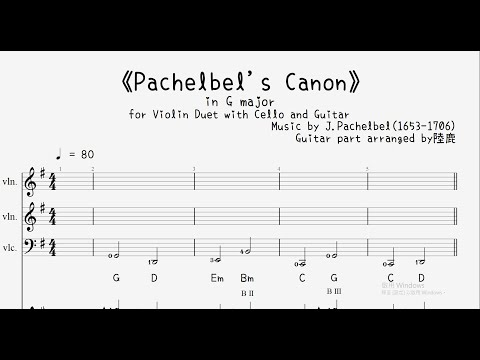


《Pachelbel's Canon》in G (_for Violin Duet with Cello and Guitar)- J.Pachelbel(1653-1706)
Acoustic Guitar, Violin, Cello Normal
$3.00
- Performance Video
- Difficulty: Normal
- 6 Pages
Key Information
- Instrument 3
- Acoustic GuitarViolinCello
- Pages
- 6
- Difficulty
- Normal
- Type
- 4 Staves
- Instrumentation
- Ensemble
- Lyrics
- Not included
- Chord
- Included
- Key
- G major
- Time signature
- 4/4
- Tempo
- 60~75bpm
- Measures
- 34 measures
- Range
- C2 – E5
- Max voices
- 3 voices
- Fingering
- Marked throughout
Description
一、背景介紹 約翰·帕赫貝爾(Johann Pachelbel, 1653–1706)是德國巴洛克時期的重要作曲家,他的《Canon in D》是最廣為流傳的作品之一。本編曲採用 G 大調,由 雙小提琴、低音大提琴與吉他組成。此版本中,兩把小提琴以模仿卡農的方式層層展開旋律,大提琴持續提供低音進行,而吉他則透過分解和弦與和聲填充,使整體音響更為豐富。新版的吉他伴奏在保持低音穩固的同時,增加了琶音流動感與和聲動態,讓音樂在合奏中更有層次與推進力 二、曲式分析 ◆結構核心:全曲由一個 八和弦循環(ground bass) 所支撐,透過反覆出現,形成一系列變奏。 ◆卡農手法:小提琴一先奏主題,小提琴二在延遲後模仿進入,彼此交織成為層層堆疊的旋律網絡。 ◆低音基礎:大提琴以固定的低音進行貫穿全曲,確立和聲框架。 ◆吉他伴奏:新版吉他伴奏在不同段落中採用 分解和弦型 與 低音強調型,既維持巴洛克「持續低音」(continuo)的特徵,又增添細膩的聲部層次。 ◆整體曲式:屬於「變奏型卡農」結構,每一次和弦循環都帶來旋律與伴奏層次的遞進,直到最後收束。 三、和聲進行 ◆固定使用 G 大調八和弦循環: G – D – Em – Bm – C – G – C – D 羅馬數字分析: I – V – vi – iii – IV – I – IV – V ◆功能解析: G (I):建立主調中心。 D (V):屬和弦,製造張力並推向 vi。 Em (vi):相對小調,增加陰鬱色彩。 Bm (iii):過渡小和弦,引向 IV。 C (IV):下屬和弦,提供溫和安定感。 G (I):短暫回歸主調。 C (IV):再次延伸,避免早期終止。 D (V):屬和弦,導回 I,進入下一輪循環。 四、總結 《Canon in G》以雙小提琴的卡農旋律、大提琴的低音 ostinato 與吉他的分解和聲,共同塑造了清澈卻層次豐富的合奏音響。新版吉他伴奏的設計,既承襲巴洛克時期的持續低音功能,又提供現代合奏所需的動態與流動感。 English 一、Background Johann Pachelbel (1653–1706) was a prominent German Baroque composer, best known for his Canon in D. This arrangement is set in G major for two violins, cello, and guitar. The violins engage in imitative canon entries, the cello maintains the repeating ground bass, while the guitar enriches the harmony with flowing arpeggios and chordal support. The revised guitar part provides both harmonic stability and a sense of forward motion, enhancing the ensemble texture and dynamic progression 二、Formal Analysis ◆Core structure: The entire piece is built on a repeating 8-chord ground bass cycle, generating a sequence of variations. ◆Canonic writing: Violin I introduces the theme, followed by Violin II in delayed imitation, creating contrapuntal layering. ◆Bass foundation: The cello maintains the ground line throughout, securing harmonic stability. ◆Guitar part: In this revised edition, the guitar alternates between arpeggiated textures and bass-driven patterns, functioning as a continuo instrument while adding depth and movement. ◆Overall form: A “variation canon,” where each repetition of the ground fosters new melodic elaborations and textural growth, culminating in a concluding cadence. 三、Harmonic Progression ◆The version employs a fixed 8-chord cycle in G major: G – D – Em – Bm – C – G – C – D Roman numerals: I – V – vi – iii – IV – I – IV – V ◆Functional outline: G (I) — tonic, establishes the tonal center. D (V) — dominant, drives harmonic tension. Em (vi) — relative minor, introduces darker color. Bm (iii) — mediant, transitional chord leading to IV. C (IV) — subdominant, gentle repose. G (I) — tonic return, brief resolution. C (IV) — prolongs subdominant, avoids early closure. D (V) — dominant, strongly leading back to tonic in the next cycle. 四、Harmonic Progression In this G-major Canon, the violins’ canonic lines, the cello’s ostinato bass, and the guitar’s harmonic elaborations together create a transparent yet layered sonority. The revised guitar part preserves the continuo role of the Baroque era while offering modern flexibility and expressive motion within the ensemble.
$3.00
