
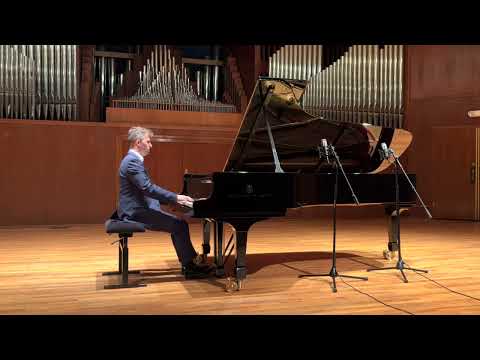


Etude Op. 2 No. 2 in E minor-S. Prokofiev
Klavier Schwer
$2.99
 Performance-Video
 Schwierigkeit: Schwer
 4 Seiten
Wichtige Infos
- Instrument 1
- Klavier
- Seiten
- 4
- Schwierigkeit
- Schwer
- Typ
- 2 Systeme
- Instrumentierung
- Solo
- Liedtext
- Nicht inkl.
- Akkord
- Nicht inkl.
- Instrument
- Klavier
- Seiten
- 4
- Schwierigkeit
- Schwer
- Typ
- 2 Systeme
- Instrumentierung
- Solo
- Liedtext
- Nicht inkl.
- Akkord
- Nicht inkl.
Beschreibung
S. Prokofiev - Etude Op. 2 No. 2 in E minor
🎼 About the Piece
Prokofiev’s Etude Op. 2 No. 2 moves through a shadowed musical world where restrained melodic fragments, shifting accents, and unsettled harmony create an atmosphere of quiet suspicion and inward tension.
Its surface may appear calm, yet independent rhythmic layers and concealed contrapuntal lines continually disturb the balance, revealing a work whose emotional unease grows through precision rather than outward force.
✨ Sheet Music Highlights
This score is especially valuable for developing rhythmic independence, layered voicing, chordal balance, controlled articulation, and the coordination of musical lines that do not always move or breathe together.
The writing sharpens awareness of inner voices, subtle accents, harmonic direction, pedal clarity, and the ability to maintain concentration through textures whose difficulty is hidden beneath a restrained exterior.
🎹 Performance & Recommendation Points
The principal line should remain clearly audible without being exaggerated, while the accompanying layers retain their own rhythmic identity and never dissolve into an indistinct background.
Accents need character without harshness, and carefully measured tonal changes will allow the music’s quiet instability to deepen naturally instead of becoming overly heavy or theatrical.
Have a happy performance!
$2.99

Beschreibung
S. Prokofiev - Etude Op. 2 No. 2 in E minor
🎼 About the Piece
Prokofiev’s Etude Op. 2 No. 2 moves through a shadowed musical world where restrained melodic fragments, shifting accents, and unsettled harmony create an atmosphere of quiet suspicion and inward tension.
Its surface may appear calm, yet independent rhythmic layers and concealed contrapuntal lines continually disturb the balance, revealing a work whose emotional unease grows through precision rather than outward force.
✨ Sheet Music Highlights
This score is especially valuable for developing rhythmic independence, layered voicing, chordal balance, controlled articulation, and the coordination of musical lines that do not always move or breathe together.
The writing sharpens awareness of inner voices, subtle accents, harmonic direction, pedal clarity, and the ability to maintain concentration through textures whose difficulty is hidden beneath a restrained exterior.
🎹 Performance & Recommendation Points
The principal line should remain clearly audible without being exaggerated, while the accompanying layers retain their own rhythmic identity and never dissolve into an indistinct background.
Accents need character without harshness, and carefully measured tonal changes will allow the music’s quiet instability to deepen naturally instead of becoming overly heavy or theatrical.
Have a happy performance!